AN OPEN LETTER TO MEMBERS OF CONGRESS ABOUT OUR STAFFING PLIGHT
TO: United States Members of Congress
FROM: Resistance Rangers—rangers (off-duty and former)
SUBJECT: Ongoing National Park Service Hiring Restrictions Are Hurting Parks
We are writing with an urgent message to ensure you understand the reality from the field before it shapes this year's funding decisions: National Park Service hiring isn't frozen anymore, but it might as well be. Approvals now move so slowly, it's like hiring is stuck in tar.
You may have already seen a trickle of job postings for national parks on USAJOBS this year. It would be reasonable to look at those postings and conclude that the staffing crisis has passed, and that parks are staffing back up to meet visitor demand. We are asking you to look more closely, because the reality is very different.
What is actually happening
This spring, DOI leadership imposed a new approval structure that strips hiring authority away from the people who actually run and protect parks. A park superintendent or regional office used to be able to fill a vacant position on their own and not have any restrictions on which positions could be hired as internal or external to the agency.
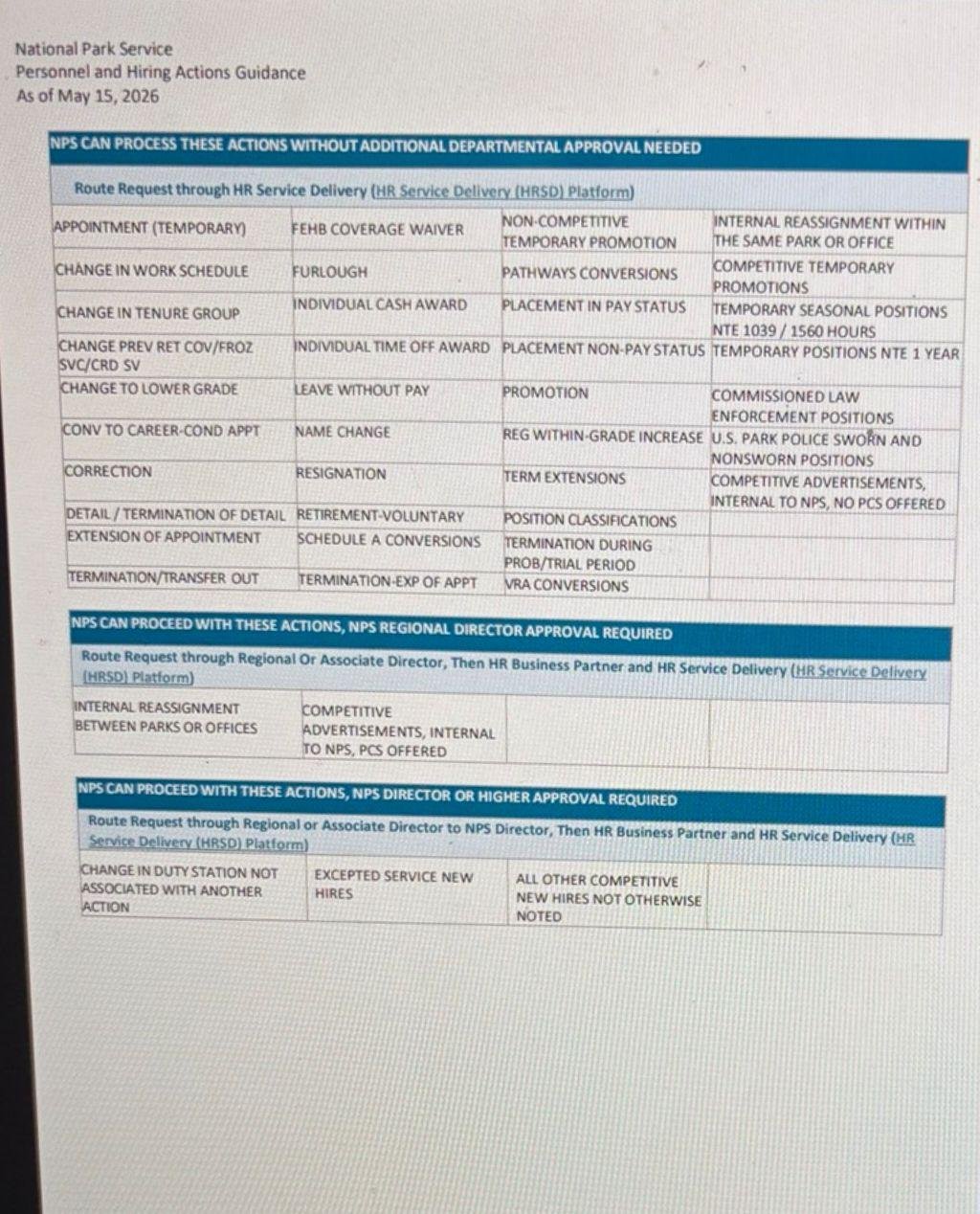
Current hiring guidance was emailed to staff in July 2026, as seen in this photo
To reassign someone between parks or offices, make changes to a park's organizational chart, or to offer an internal candidate a Permanent Change of Station (monetary support for the move), now a hiring official needs Regional Director sign-off. And to bring on someone from outside the agency, approval has to come from the "NPS Director or higher."
Does this sound like an efficient system to you? Should the NPS Director be spending their time on field-level hiring decisions for every single new agency hire?
It certainly does not sound efficient to us. Yet it has played out exactly how it was intended to: it is a system engineered to slow hiring down at every turn, gutting our staff and endangering our public lands.
When a hiring official knows that filling a position requires sign-off from the Secretary of the Interior, they stop asking for critical roles like biologists, archaeologists, educators, communicators, and wilderness and compliance specialists. If they do ask, it takes months to hear back—if they hear back at all—and the answer is often "no."
Most hiring managers have shifted to filling roles with internal NPS candidates instead, since there are fewer hoops to jump through. But internal hiring solves nothing — it just creates an identical vacancy in a critical position somewhere else, moving the shortage from one park to another rather than fixing it.
Some of the hardest staffing hits have come at regional offices, whose skilled staff support multiple parks. Smaller parks without the capacity or budget to hire specialized staff of their own are left watching projects stall and expertise wither.
HR staff—the people needed to execute any hiring action—have themselves seen their ranks decimated, on top of being consolidated into the Department of the Interior. They've lost a significant number of employees to consolidation efforts and the Deferred Resignation Program, which was designed to push staff out regardless of the effect on the agency. As a result, even approved positions often go unprocessed for months on end. We've even been told not to follow up on the status of hiring packages, because HR doesn't have the staff to respond.
The Secretary of the Interior is only allowing us to reshuffle the same shrunken pool of employees from one vacancy to another, within staffing limits newly imposed on each region. When vacancies in the NPS are filled through an internal hire that ranger is pulled from one park to cover a hole in another. The job posting and hiring process looks like progress, but the park that lost that ranger is now short-staffed in their place. Total capacity across the system does not change; the shortage just shuffles around and NPS staffing levels continue to steadily fall.
An important exclusion
Guidance is explicit about who counts as what. In internal communications, NPS leadership wrote:
"External hires refer to anyone not currently working in a permanent position with the NPS (e.g., NPS seasonal employees, NPS term employees, DOI employee, other federal agency, outside of government)."
Read that definition closely: an "internal" hire is a permanent NPS employee moving into another existing permanent job. That's it. A seasonal ranger, a term employee, or someone from another DOI bureau—even those former NPS employees recently consolidated to the DOI by Secretary Burgum's questionably legal reorganization in April 2025—all count as external, meaning even filling a vacancy with an existing, experienced Park Service ranger can still count against the region's hiring cap.
This targets the NPS employees who were taken from the agency and reassigned to DOI without any oversight or input from Congress and remain in limbo. These employees, many of whom served their entire careers in the NPS, are now employed by the DOI and so can no longer apply for NPS jobs unless they are "approved by the NPS director or higher".
Voices from the field
Numbers and policy memos tell part of the story. The people doing the work can tell the rest of it. Below are examples from current and former Park Service employees describing what these staffing shortages mean day to day.
“At Joshua Tree National Park, we celebrated the opening of our new greenhouse but our nursery manager position has been vacant since December 2024. How can we save the Joshua trees without a nursery manager to grow them? Other vacant NPS positions include our entire wildlife staff, all of our physical scientists, all of our archaeologists and all of our off-highway vehicle management team. We can't protect the desert tortoise, restore abandoned mines, monitor air quality, preserve historic sites, or restore damage from off road vehicles without these staff. Even if we did get through the endless maze of approvals to replace these critical vacancies, the lack of HR staff makes it so we wouldn't know where to start. Messages to HR go ignored for months and we never hear back. Without them, we couldn't hire to replace a vacant position even if we were allowed to.”
“I work at a small historic site without a lot of staff. We lost half of our interpretive staff when all probationary staff were fired, so we had to dramatically and disruptively cut down the days and times by over 50% the site is open to the public. This has had the combined effect of lowering staff morale as we are limited in accomplishing the mission we love, creating confusion and disappointment among public who find it difficult to visit, and created an environment where remaining staff are fearful of who may be arbitrarily fired next.”
“My partner is a wildland firefighter who recently moved across the country. I've been talking to another park near him that has an open position that they’d like to offer me, but because of all of these bureaucratic restrictions, they are being told by HR that I’m not allowed to switch into that role. It's making it impossible to both continue being a public servant, and be near my partner. They're just finding every way possible to make it so miserable they push us out. In addition to my personal frustrations, we repeatedly laud wildland firefighters as our nations heroes, and yet are doing things like this that take away their support systems unnecessarily.”
“A coworker was on a standard ladder position, the kind where you move from a GS-5 to 7 or 9 over a few years as long as you perform well- the way the NPS has always promoted people. Their promotion, which should have been a non-issue, was withheld from a full-time employee, presumably due to the chilling effect on hiring and promotions. As a result, they left for the private sector. There's no plan to rehire their position, so management is strategizing spreading out their work (which is specialized) among the remaining staff who are not specialized in that area.”
“I can attest that zero upward mobility has everyone on the ground certain they are locked in place where they are and that's a motivation killer. Long gone are the rockstar attitudes to shoot for the stars to build a good resume to get you to the next step. The abject fear of beginning a new probationary period is very real. Even if there were some opportunities to move, I wouldn't want to risk starting a new probationary period. I feel the only safe(r) choice is to stay static at all costs.”
“There's no development opportunities when you've made it into the job, so I can't even imagine trying to get in the door right now. Especially in a specialized position like biology or archaeology.”
“Someone showed me a list of all HR actions currently being worked on and they were almost all VRP (visitor resource protection) or United States Park Police positions. We were playing a game to see who could spot other jobs in an unfiltered list while we scrolled.”
Why this matters for FY2027 appropriations
In Secretarial Order 3426, Interior Secretary Burgum has said that keeping parks "open and accessible" to the public is a priority. In some ways, we agree- we need more staff to fulfill our mission. But his hiring restrictions makes that goal impossible to achieve. Only Congress can break this cycle.
We are asking appropriators to:
Fully fund National Park Service staffing in the FY2027 Interior-Environment appropriations bill at a level sufficient to rehire the roughly 4,000 permanent positions lost since January 2025 and a fully-staffed seasonal workforce.
Fully fund all public lands staffing in the FY2027 appropriations bills. The National Park Service cannot operate in isolation—wildfires jump boundaries, wildlife crosses lines, and the agency depends on fully staffed neighbors like the Forest Service and Fish and Wildlife to do its job.
Hold the administration to its own stated commitment to keeping parks open and accessible by tying that commitment to pre-2025 staffing levels: visitor services, search and rescue, park maintenance, resource management, and interpretation cannot function on a skeleton crew.
Require transparency around current staffing levels, staffing caps, which positions are getting hired, and who they are open to.
Every seasonal job posting and internal move is a sign that Park Service leadership on the ground is trying to keep parks functioning. It is not a sign that the underlying staffing crisis has been resolved. We are asking you to see this appropriations cycle clearly, and to fund the National Park Service at the level its mission — and the 325+ million people who visit these parks every year — actually requires.
Sincerely,
Resistance Rangers
A network of current, former, and fired National Park Service employees
Appendix: Some staffing data
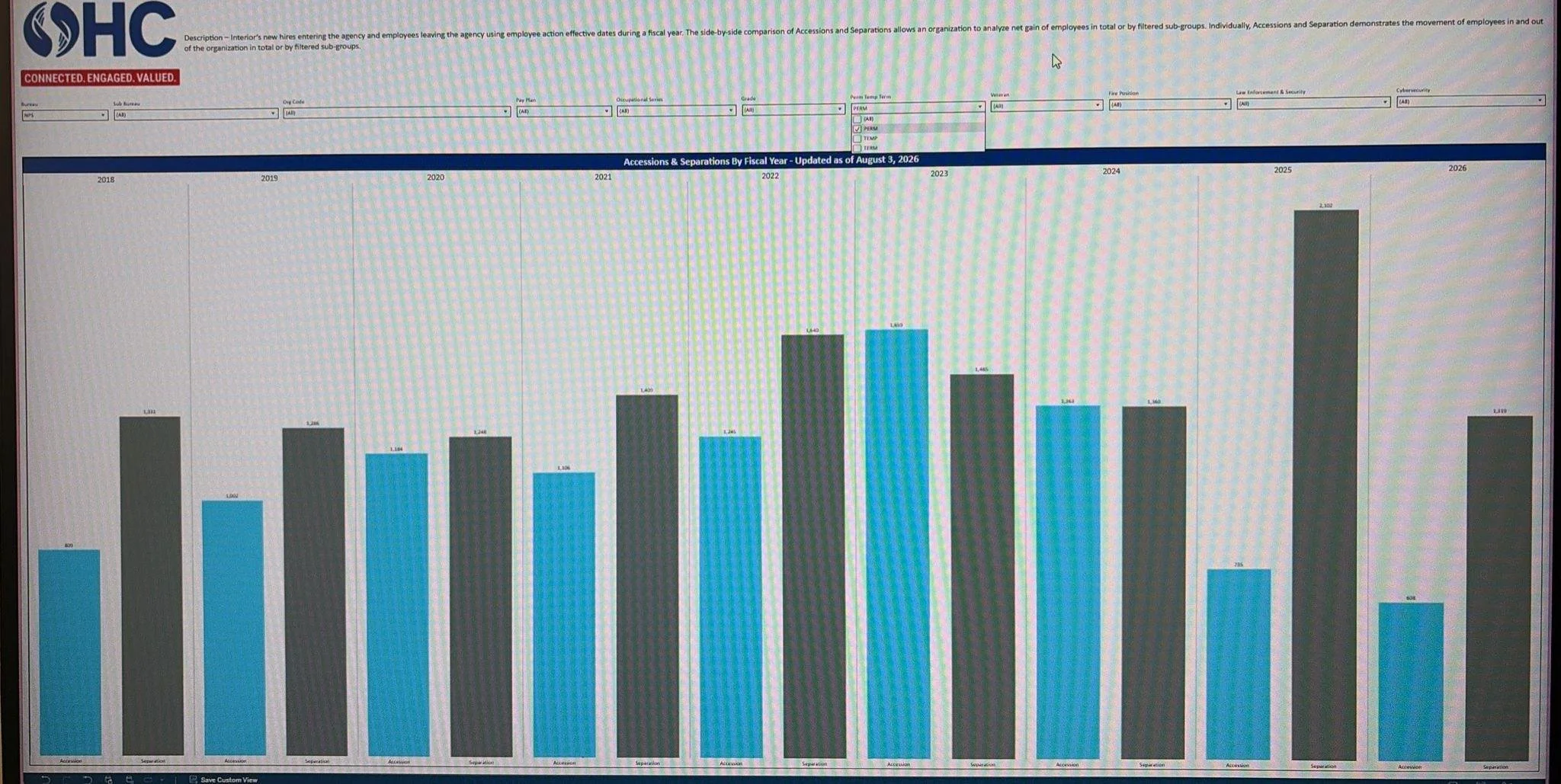
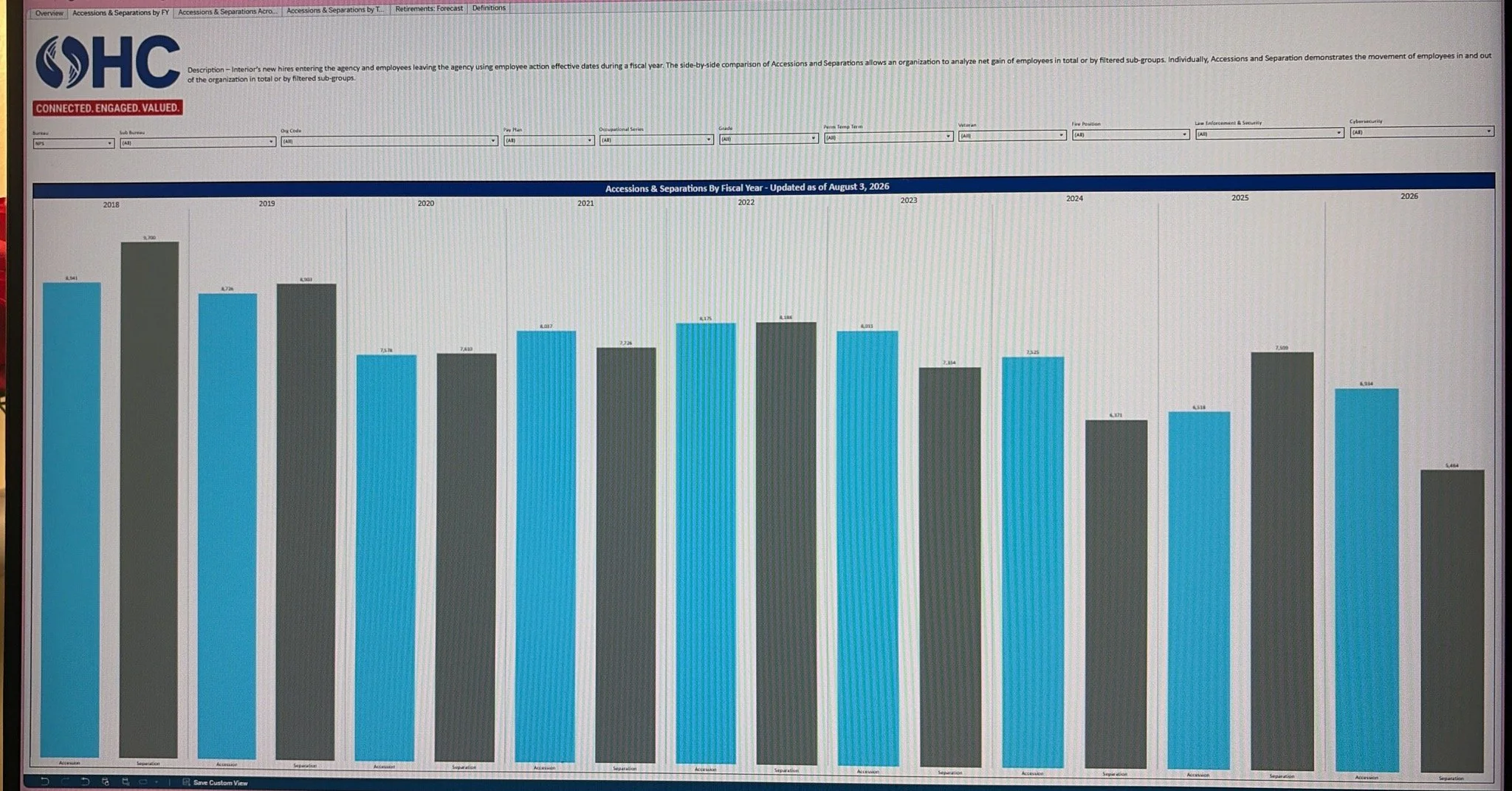
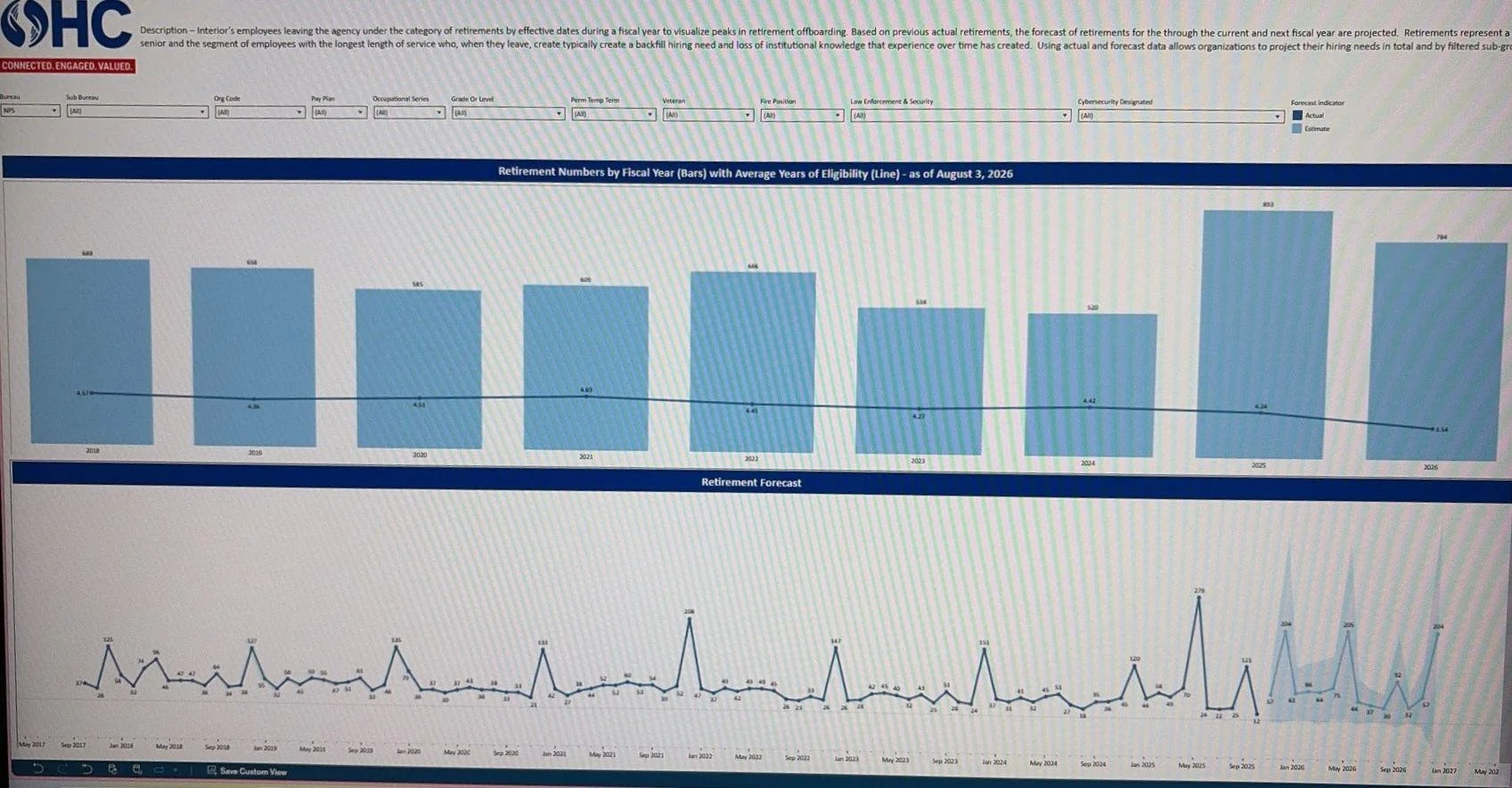
Permanent staff—the backbone of institutional knowledge and full-time capacity at the park service—are plummeting: permanent separations are outpacing permanent accessions, with the gap widening sharply in FY2026. At the same time, overall staffing levels, including seasonal employees, are also rapidly declining. And retirements are forecasted to spike even further in the coming year, threatening to accelerate the loss of experienced staff just as the agency is least equipped to backfill it.